Periodic Table of Elements: Structure, Symbols, and Key Facts
The periodic table of elements stands as one of the most iconic and indispensable tools in all of science. It is far more than a colorful chart hanging on classroom walls — it is a masterfully organized map of the building blocks that make up everything in the universe, from the air we breathe to the stars scattered across the night sky. With 118 confirmed elements and counting, the periodic table distills centuries of chemical discovery into a single, elegant framework that scientists, students, and researchers rely on every single day.
What Is the Periodic Table?
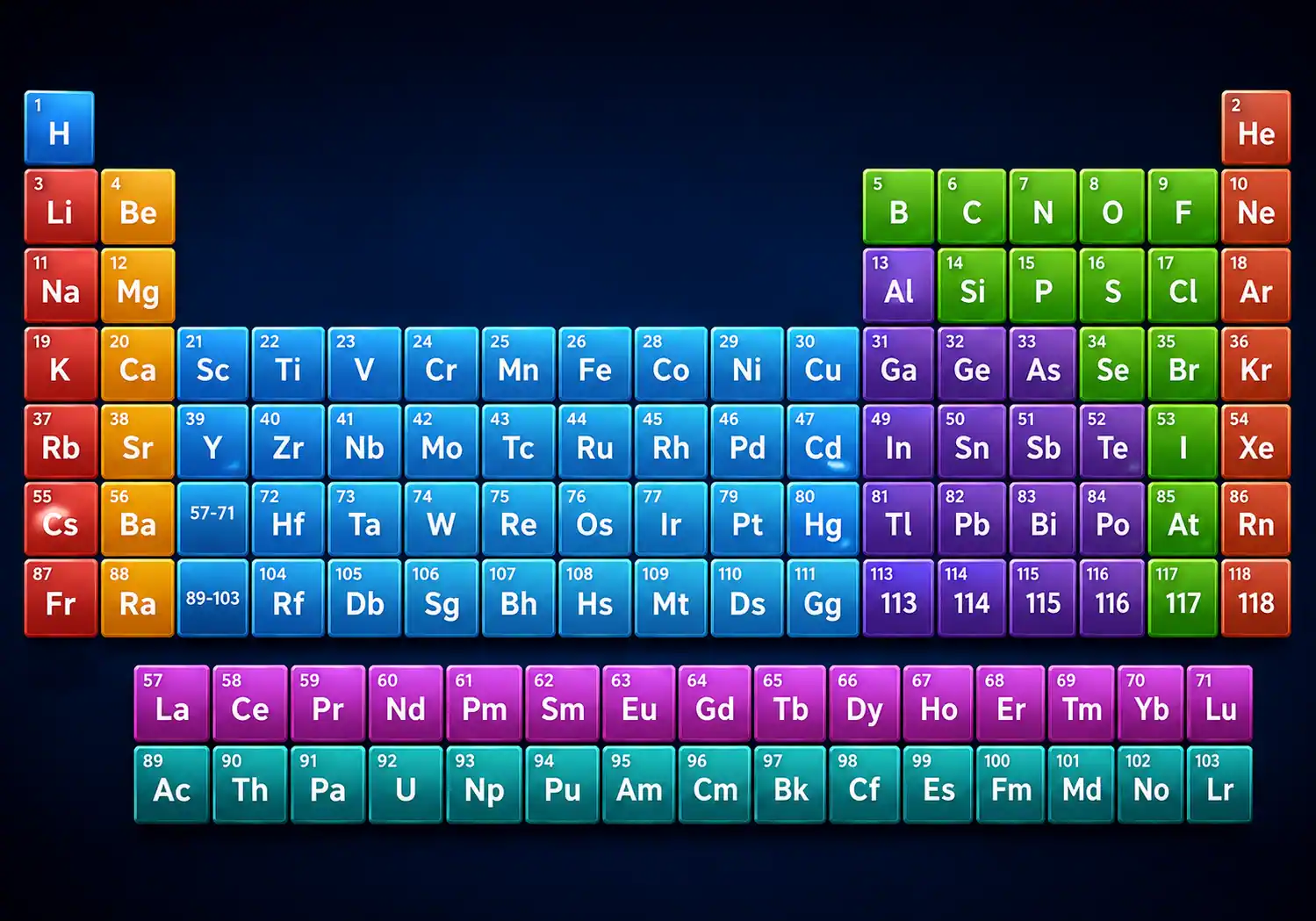
At its core, the periodic table is a systematic arrangement of all known chemical elements, organized by their atomic number, electron configuration, and recurring chemical properties. The genius of the table lies in its structure: elements are placed in rows and columns where patterns emerge, allowing anyone familiar with its layout to predict how an element will behave even if they have never studied it before.
When Dmitri Mendeleev first published his version of the periodic table in 1869, he left intentional gaps for elements that had not yet been discovered. Remarkably, he predicted the properties of these missing elements with astonishing accuracy. Decades later, when elements like gallium and germanium were found, they fit neatly into the slots Mendeleev had reserved — a testament to the predictive power of this organizational system.
How the Periodic Table Is Organized
Understanding the layout of the periodic table unlocks its true value. Every element’s position tells a story about its atomic structure and chemical personality.
Periods: The Horizontal Rows
The seven horizontal rows of the periodic table are called periods. As you move from left to right across a period, each element gains one proton in its nucleus and one electron in its outer shell. This incremental change drives a gradual shift in properties — for instance, elements on the left side of a period tend to be highly reactive metals, while those on the right edge are often nonmetals, culminating in the completely inert noble gases at the far-right column.
Groups: The Vertical Columns
The eighteen vertical columns, known as groups or families, contain elements that share the same number of electrons in their outermost shell. This shared electron configuration means that elements within the same group generally exhibit strikingly similar chemical behaviors. For example, Group 1 houses the alkali metals — lithium, sodium, potassium, and their relatives — all of which are soft, silvery metals that react vigorously with water. Group 18, on the other hand, contains the noble gases like helium and neon, which are famously unreactive due to their full outer electron shells.
Blocks: The Deeper Pattern
Beyond periods and groups, the periodic table can also be divided into four distinct blocks — s-block, p-block, d-block, and f-block — based on which type of atomic orbital the outermost electrons occupy. The s-block spans Groups 1 and 2, the p-block stretches from Group 13 to 18, the d-block encompasses the transition metals in Groups 3 through 12, and the f-block contains the lanthanides and actinides, which are typically displayed as two detached rows beneath the main table for readability.
Understanding Element Symbols
Every element on the periodic table is represented by a one- or two-letter chemical symbol. These symbols are more than convenient shorthand — they serve as a universal language for chemists around the world, transcending linguistic barriers. The symbol for gold is Au, derived from the Latin word aurum. Sodium is Na, from natrium. Iron bears the symbol Fe, from ferrum. This historical connection to Latin and other ancient languages adds a layer of richness to the table, reminding us that chemistry is a field built upon centuries of cumulative knowledge.
Some symbols align intuitively with their English names — H for hydrogen, O for oxygen, C for carbon. Others require a bit more memorization, but each one tells part of the story of how that element was discovered, named, and understood by the scientists who first isolated it.
Major Categories of Elements
The periodic table can be broadly divided into three categories, each with its own distinctive set of characteristics.
Metals
The overwhelming majority of elements are metals. Found primarily on the left side and center of the table, metals are typically shiny, dense, and excellent conductors of heat and electricity. They are malleable, meaning they can be hammered into sheets, and ductile, meaning they can be drawn into wires. The transition metals — including iron, copper, nickel, and zinc — occupy the d-block and are prized for their strength, versatility, and ability to form colorful compounds. The alkali metals and alkaline earth metals in Groups 1 and 2 are among the most reactive substances known, rarely found in their pure form in nature.
Nonmetals
Nonmetals occupy the upper-right corner of the table and include elements essential to life, such as carbon, nitrogen, oxygen, and phosphorus. Unlike metals, nonmetals are generally poor conductors of heat and electricity, and they tend to be brittle in their solid forms. Their chemical diversity is immense — some, like oxygen, are highly reactive, while others, like the noble gases, are almost entirely inert.
Metalloids
Straddling the boundary between metals and nonmetals are the metalloids — boron, silicon, germanium, arsenic, antimony, tellurium, and sometimes polonium. These elements possess a mix of metallic and nonmetallic properties, which makes them extraordinarily useful in the electronics industry. Silicon, for instance, is the backbone of modern computer chips and solar panels precisely because its semiconducting properties can be finely tuned.
The Lanthanides and Actinides
The two rows placed beneath the main body of the periodic table are often overlooked, but they contain some of the most fascinating elements in existence. The lanthanides — the top row of the f-block — include elements like neodymium, used in powerful magnets found in wind turbines and electric vehicles, and europium, which helps produce the vibrant red colors in television and smartphone screens.
The actinides — the bottom row — are dominated by radioactive elements, most notably uranium and plutonium. These heavy elements play a critical role in nuclear energy production and have applications in medicine, space exploration, and scientific research. Many actinides are synthetic, meaning they were created in laboratories rather than found in nature, highlighting humanity’s ability to expand the boundaries of the periodic table itself.
Key Facts Worth Knowing
The periodic table is filled with intriguing details that capture the imagination. Hydrogen, the first element, makes up roughly 75% of all baryonic mass in the universe. Helium, the second element, is the only substance that cannot be solidified into a frozen state at atmospheric pressure, no matter how low the temperature drops. The heaviest naturally occurring element is uranium, with an atomic number of 92, while every element beyond that has been synthesized in laboratories or nuclear reactors. As of 2026, oganesson — element 118 — holds the title of the heaviest element ever created, named in honor of the Russian physicist Yuri Oganessian.
Why the Periodic Table Matters
The periodic table is not simply a reference tool — it is a dynamic framework that continues to evolve. Researchers are currently exploring the potential existence of an “island of stability,” a theoretical region of superheavy elements that might be far more stable than their neighbors. If such elements can be synthesized, they could open entirely new chapters in chemistry and materials science.
In classrooms, the periodic table serves as a gateway to scientific thinking. It teaches students to recognize patterns, make predictions, and appreciate the underlying order of the natural world. In laboratories, it guides researchers toward new compounds, new materials, and new technologies. The periodic table is, quite simply, one of humanity’s greatest intellectual achievements — a testament to our ability to find order in complexity and to organize the raw materials of the cosmos into a coherent, beautiful, and endlessly useful system.
Author Bio: Dr. Elena Marchetti is a science communicator and former chemistry educator who writes about the natural world with clarity, curiosity, and a passion for lifelong learning.