
Do the Driving Modes in Cadillac Lyriq Affect Range or Battery Usage?
Introduction
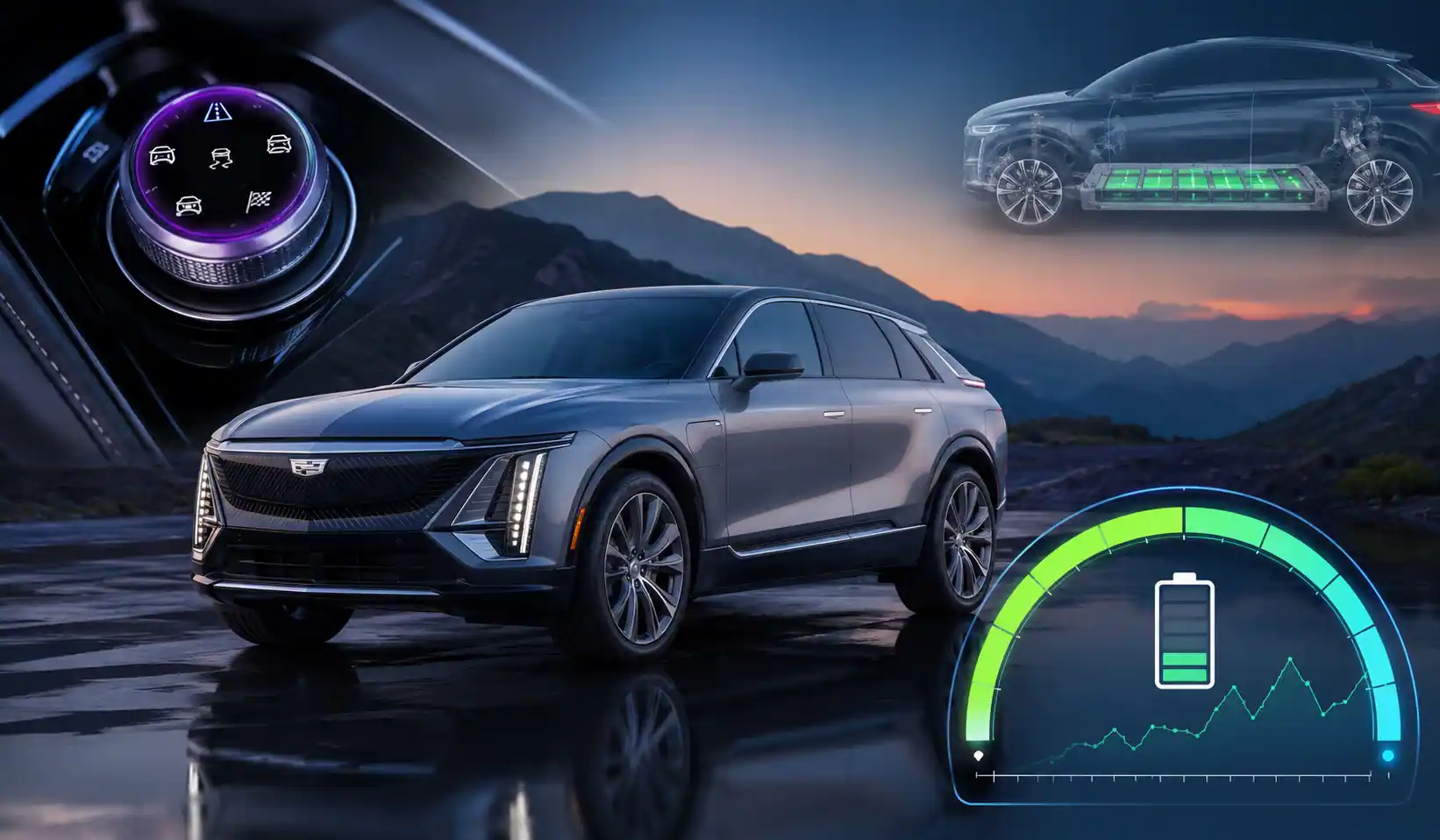
When you slide behind the wheel of a Cadillac Lyriq, you are stepping into more than just a luxury electric vehicle. You are entering a cockpit shaped by intelligent software, adaptive hardware, and a philosophy that driving should feel personal. One of the most talked-about features in the Lyriq is its selectable driving modes. But among all the praise for smooth acceleration and quiet cabins, a practical question keeps surfacing: do these driving modes actually affect how far you can go on a single charge? The short answer is yes. The longer answer reveals a cleverly engineered system where your driving preferences directly influence range, battery consumption, and the overall efficiency of the vehicle. Let’s explore exactly how this works.
Understanding the Driving Modes in the Cadillac Lyriq
Before diving into the numbers, it is important to understand what each driving mode is designed to do. The Lyriq offers several distinct modes, each adjusting throttle response, steering weight, regenerative braking behavior, and even climate control intensity. These changes are not cosmetic. They alter how the vehicle consumes energy with every mile you travel.
Tour Mode: Balanced and Everyday-Ready
Tour mode is the default setting and the one most drivers will use for daily commuting. It strikes a balance between responsiveness and efficiency. Throttle mapping feels smooth and predictable, steering is light, and the regenerative braking system operates in a moderate state. The vehicle does not aggressively conserve energy here, nor does it waste it. For mixed city and highway driving, Tour mode generally delivers the range closest to GM’s official EPA estimates.
Sport Mode: Performance with a Cost
Sport mode transforms the Lyriq into something noticeably sharper. The accelerator becomes more sensitive, power delivery feels immediate, and the steering tightens up for a more connected feel. Behind the scenes, the battery management system allows the motors to draw power more freely. The result is a genuinely engaging drive, especially from a vehicle weighing over 5,500 pounds. However, this enthusiasm comes at the expense of efficiency. Aggressive throttle mapping encourages harder acceleration, and more frequent power surges draw energy from the battery at an accelerated rate. In Sport mode, drivers can expect a measurable reduction in total range, often between five and fifteen percent, depending on driving habits.
Snow/Ice Mode: Safety Over Speed
Snow/Ice mode is designed for low-traction conditions. It softens throttle response significantly, reduces peak motor torque, and adjusts the all-wheel-drive system, if equipped, to prioritize stability. From an energy perspective, this mode actually promotes gentler driving. The reduced throttle sensitivity makes it harder to spike power consumption, which can inadvertently lead to more efficient energy use in slippery conditions. However, the traction control and heating systems may draw additional power, and cold weather itself reduces battery performance. The net effect on range is situational, with the mode’s safety benefits far outweighing any minor efficiency differences.
My Mode: Personalization Meets Efficiency
My Mode allows drivers to customize steering, braking feel, and accelerator response independently. This is where efficiency-conscious owners can get creative. By pairing a relaxed throttle map with firmer regenerative braking, you can build a driving profile that maximizes range without sacrificing comfort. A driver disciplined enough to set gentle acceleration parameters in My Mode may achieve range figures that rival or even exceed Tour mode.
How Driving Modes Actually Impact Battery Usage
The relationship between a driving mode and battery consumption is not arbitrary. Each mode adjusts three key variables that directly determine how quickly the battery depletes.
Throttle Mapping and Power Delivery
The most significant factor is how the accelerator pedal translates foot pressure into motor output. In Sport mode, a small pedal movement commands a large torque request. In Snow/Ice mode, the same pedal travel might request only a fraction of available torque. These differences directly affect how much current flows from the battery. Rapid, high-torque events are the single biggest drain on an EV battery, and driving modes that encourage or enable these events naturally consume more energy per mile.
Regenerative Braking Settings
The Lyriq features an on-demand regenerative braking paddle, but the baseline regen level also shifts between modes. Sport mode typically reduces regenerative braking to create a more traditional driving feel, meaning the vehicle recaptures less energy during deceleration. Tour mode maintains moderate regen, while Snow/Ice mode may increase it to help control speed on slippery surfaces without friction brakes. More aggressive regen puts energy back into the battery and extends range, especially in stop-and-go traffic. Modes that dial back regeneration effectively reduce the vehicle’s ability to recover energy.
Climate Control and Ancillary Loads
Some driving modes subtly adjust how the HVAC system operates. In Sport mode, the climate system may prioritize cabin comfort without regard for energy savings. In Snow/Ice mode, the system might direct more energy toward battery thermal management and defrosting. These ancillary loads can account for a surprising portion of total energy consumption, particularly in extreme temperatures. A mode that runs the heater or air conditioner more aggressively will reduce range independently of how the vehicle is being driven.
Real-World Range Differences: What Owners Report
Owner experiences and independent tests paint a consistent picture. In Tour mode with moderate driving, the Lyriq’s range aligns closely with its EPA rating of approximately 307 to 314 miles, depending on the configuration. Switching to Sport mode and driving with enthusiasm can bring that number down to roughly 260 to 280 miles in real-world conditions. Drivers who spend time in Snow/Ice mode during winter months often report range reductions of twenty to thirty percent, though this is largely attributable to cold temperatures rather than the mode itself.
What is particularly interesting is that careful use of My Mode and the regenerative braking paddle can push range beyond EPA estimates in ideal conditions. Some Lyriq owners on forums report achieving over 320 miles on a single charge by blending a gentle throttle profile with maximum regenerative braking. The mode is not the only variable at play, but it sets the stage upon which driving behavior unfolds.
One-Pedal Driving: A Hidden Efficiency Tool
The Lyriq’s one-pedal driving feature deserves special mention because it operates alongside the driving modes and has a profound effect on battery usage. When one-pedal driving is activated, lifting off the accelerator applies strong regenerative braking, slowing the vehicle without touching the brake pedal. This feature is not tied to a specific driving mode, meaning you can activate it in Sport, Tour, or any other mode.
In practice, one-pedal driving consistently improves efficiency in urban and suburban environments by maximizing energy recapture during frequent stops. On the highway, its impact is less dramatic because deceleration events are fewer. Drivers who master one-pedal driving often find that their choice of base driving mode matters less for efficiency than their use of this feature. Combining one-pedal driving with Tour mode or a gentle My Mode profile represents the most range-conscious configuration available.
Battery Preconditioning and Mode Interaction
Another layer worth understanding involves battery thermal management. The Lyriq can precondition its battery, warming or cooling it to an optimal temperature before charging or driving. While preconditioning is not a driving mode in the traditional sense, it interacts with mode selection in meaningful ways. A preconditioned battery operates more efficiently, and driving modes that stress the battery with high current demands, like Sport mode, benefit more noticeably from a properly conditioned pack.
During cold weather, using Snow/Ice mode on a preconditioned battery can yield significantly better range than switching to that mode on a cold-soaked battery. GM recommends preconditioning while plugged in whenever possible, as this draws energy from the grid rather than the battery itself. This simple habit, combined with thoughtful mode selection, can add meaningful miles to your daily driving envelope.
Practical Guidance for Lyriq Owners
Understanding these dynamics allows owners to make informed decisions about which mode to use and when. For daily commuting with no urgency, Tour mode or a gentle My Mode profile paired with one-pedal driving offers the best balance of comfort and range. For highway road trips, sticking with Tour mode and using the adaptive cruise control to maintain steady speeds will maximize distance between charging stops. If the road ahead features a winding canyon and you want to enjoy the Lyriq’s surprisingly capable chassis, switching to Sport mode is perfectly acceptable. The range penalty is real but manageable, and the driving experience is genuinely rewarding.
In winter conditions, Snow/Ice mode should be used without hesitation when roads are slick. Any theoretical impact on range is secondary to the safety benefits. Precondition the battery while plugged in, dress warmly to reduce cabin heating demands, and rely on the heated seats and steering wheel rather than blasting cabin heat, as these localized heaters consume far less energy.
The Bigger Picture: Why GM Designed It This Way
GM’s engineers did not set out to create driving modes that simply toggle range on and off. They designed a system that gives drivers agency over how their vehicle behaves, trusting them to make intelligent trade-offs. A Lyriq driven in Sport mode still achieves better efficiency than most gasoline SUVs, and its range remains practical for the vast majority of daily driving scenarios. The point of the driving mode selector is not to punish drivers for seeking engagement. It is to offer flexibility, and the range differences between modes are a natural consequence of delivering that flexibility.
In an era where range anxiety still looms large for many EV newcomers, the Lyriq’s transparent and predictable mode behavior is an asset. Drivers quickly learn the rhythm of their chosen settings and how they translate to remaining range. The guess-o-meter on the dashboard adapts to driving style and mode selection in real time, providing increasingly accurate range predictions as the vehicle learns from the driver’s habits.
Conclusion
The driving modes in the Cadillac Lyriq do affect range and battery usage, and understanding why makes you a smarter owner. Sport mode thirsts for electrons the way a V8 thirsts for gasoline, while Tour mode sips energy with restraint. Snow/Ice mode prioritizes control and safety, with mixed but generally moderate effects on range. My Mode hands the keys to the driver, enabling a personalized efficiency formula that can outperform factory defaults.
These differences are not flaws. They are the product of intentional engineering choices that respect the driver’s ability to decide what matters most in any given moment. Whether you are chasing range records or chasing the horizon on a favorite back road, the Lyriq adapts to you. The key is knowing which mode to reach for and understanding the trade-off you are making when you twist that selector.